Is a Cheap Website Worth It? The True Cost of Budget Web Design
 Mukesh Murugan |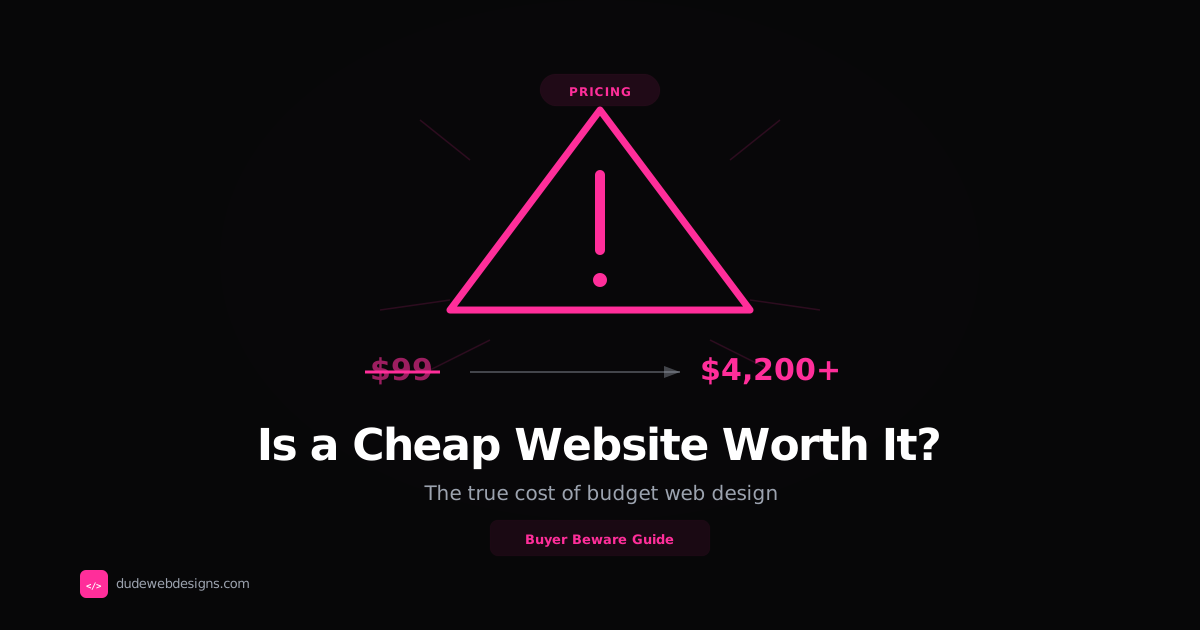
A $99 website. A $49 website. A “free” website.
The offers are everywhere — on Fiverr, on Facebook ads, in your spam folder. And when you’re a small business owner watching every dollar, the temptation is real.
But here’s the question nobody selling $99 websites wants you to ask: what does a cheap website actually cost your business?
Not the sticker price. The real cost — in lost customers, poor rankings, security issues, and the inevitable rebuild.
What You Get for $99
Let’s be honest about what ultra-budget web design actually delivers:
- A pre-made template with your logo and colors swapped in
- Generic stock photos that appear on thousands of other sites
- No SEO optimization — no meta tags, no schema markup, no keyword strategy
- Slow load times — template code is bloated by design
- No mobile optimization — it might be “responsive” but it won’t be optimized
- Zero performance testing — no Lighthouse audits, no Core Web Vitals checks
- No post-launch support — your designer moves on to the next $99 client
The website technically exists. It technically works. But it doesn’t do the one thing a business website needs to do: bring you customers.
The Real Cost of a Cheap Website
Cost #1: Lost Customers from Slow Load Times
Google’s research shows that as page load time increases from 1 second to 3 seconds, the probability of a visitor leaving increases by 32%. At 5 seconds, it jumps to 90%.
Budget websites typically load in 3–6 seconds on mobile. A professional hand-coded site loads in under 1 second.
Let’s do the math:
- Your site gets 500 visitors/month
- A 3-second load time means you lose roughly 160 of them (32%)
- If just 5% of those lost visitors would have become customers, that’s 8 lost customers/month
- At $200 average customer value, that’s $1,600/month in lost revenue
Over a year, your “$99 website” costs you $19,200 in lost business. Even if our math is optimistic by half, that’s still nearly $10,000.
Cost #2: Invisible on Google
Google uses page speed, mobile-friendliness, and Core Web Vitals as ranking factors. A slow, poorly-optimized template site won’t rank for anything competitive.
What this means practically:
- Your competitors with better websites show up on page 1
- You show up on page 3 (or not at all)
- Potential customers never even know you exist
- You end up paying for Google Ads to compensate — $500–$2,000/month
A well-built website with proper SEO can rank organically and reduce your dependency on paid advertising. One of our clients — a dentist — went from page 3 to position 2 for their primary keyword, reducing their monthly ad spend by $800 while increasing their leads.
Cost #3: Security Vulnerabilities
Budget websites are often built on outdated WordPress themes with unpatched plugins. In 2025:
- 90,000+ attacks per minute targeted WordPress sites
- The average cost of a website breach for a small business was $25,000+
- 60% of small businesses that suffer a cyberattack close within 6 months
A $99 website built with proper security? It doesn’t exist. Security requires thoughtful architecture, not just a quick template install.
Cost #4: The Credibility Tax
Your website is your first impression. Research shows that 75% of consumers judge a company’s credibility based on their website design. A cheap-looking website tells potential customers:
- “This business might not be legitimate”
- “This business doesn’t invest in quality”
- “This business might not be around tomorrow”
- “Maybe I should go with their competitor instead”
You can’t measure the exact revenue lost to poor credibility, but ask yourself: how many times have you clicked away from a website because it looked unprofessional?
Cost #5: The Inevitable Rebuild
Here’s the most predictable cost of all. In 12–18 months, you’ll realize your cheap website isn’t working. It’s not generating leads, it’s not ranking, and you’re embarrassed to send people to it.
So you hire a real professional and spend $1,500–$3,000 on a proper website. Your total spend:
$99 "cheap" website:                    $99
12 months of hosting (cheap):           $120
Lost revenue (conservative):            $5,000+
Professional rebuild:                   $1,500
───────────────────────────────────────────
True cost:                              $6,719+
Versus investing in a professional site from day one:
Professional website:                   $1,500
12 months of hosting:                   $150
Lost revenue:                           $0
───────────────────────────────────────────
True cost:                              $1,650
The “cheap” path costs 4x more. And you lost a year of potential business.
When a Budget Website Is Actually OK
We’re not saying every business needs a $2,000 website on day one. There are situations where a minimal investment makes sense:
1. You’re Validating a Business Idea
If you’re testing whether a business concept works, a simple landing page is fine. Use Carrd ($19/year) or a free Linktree page. Don’t invest $1,500 in a website for a business that might pivot in 3 months.
2. You’re a Hobby or Side Project
Not everything needs to be optimized for conversions. If you’re sharing your photography hobby or running a community book club, a free WordPress.com or Wix site is perfectly adequate.
3. Your Business Doesn’t Depend on Web Traffic
Some businesses get all their customers through referrals, word of mouth, or walk-in traffic. If your website is purely a digital business card that people check after already hearing about you, a simple one-page site is fine.
4. You’re a Student or Non-Profit
Budget constraints are real. Free tools exist for a reason, and there’s no shame in using them when you genuinely can’t afford more.
The Quality Spectrum: What Each Price Point Gets You
| Price Point | What You Get | Lighthouse Score | Lead Generation |
|---|---|---|---|
| $0–$99 | Template, stock photos, no SEO | 30–50 | Almost zero |
| $100–$500 | Better template, basic customization | 40–60 | Minimal |
| $500–$1,000 | Custom design, basic SEO, mobile-optimized | 70–85 | Moderate |
| $1,000–$2,500 | Hand-coded, full SEO, performance-optimized | 90–100 | Strong |
| $2,500–$5,000 | Agency-quality, content strategy, brand design | 80–95 | Very strong |
The jump from $99 to $1,000–$1,500 is where you get the biggest return on investment. That’s the sweet spot where professional quality becomes affordable.
How to Spot a “Cheap” Website in the Wild
Want to know if a competitor’s website was done on the cheap? Look for these telltale signs:
- Loads for more than 3 seconds — run it through PageSpeed Insights
- Generic stock photos — especially the multicultural-office-handshake photo
- “Lorem ipsum” or placeholder text — yes, this still happens
- Broken mobile layout — text overlapping, buttons too small, horizontal scrolling
- No SSL certificate — browser shows “Not Secure”
- Identical design to other sites — search the theme name in the source code
- Slow or missing contact forms — forms that take 5+ seconds to load or don’t work at all
- No analytics tracking — no way to measure anything
If your site has three or more of these signs, it’s costing you business right now.
The Investment Mindset vs. The Expense Mindset
The difference between businesses that thrive online and those that struggle often comes down to how they view their website:
Expense mindset: “What’s the cheapest way to get a website?”
- Leads to cutting corners
- Website becomes a liability
- Constantly fighting problems
- Never generates real ROI
Investment mindset: “What website will generate the best return?”
- Focuses on outcomes, not just cost
- Website becomes an asset
- Generates leads and revenue
- Pays for itself many times over
A $1,500 website that brings you 5 new customers per month at $300 average value generates $18,000/year in revenue. That’s a 1,200% return on investment. No savings account, stock, or marketing channel delivers that consistently.
Our Honest Recommendation
If your business depends on attracting customers online — and in 2026, almost every business does — invest in a professional website. You don’t need to spend $10,000, but you should spend enough to get:
- Sub-second load times (95+ PageSpeed score)
- Mobile-optimized design (not just “responsive”)
- Proper SEO setup (meta tags, schema markup, sitemap)
- Professional design that matches your brand
- Secure architecture with SSL and no vulnerabilities
- Source code ownership so you’re never locked in
For most small businesses, this means budgeting $750–$2,500 — a fraction of what most agencies charge, and worlds apart from what a $99 template delivers.
The cheapest website is the one that actually works.
Ready to invest in a website that pays for itself? See our pricing — professional hand-coded websites starting at $750 with no hidden costs. Or read our full 2026 website pricing guide for a complete breakdown of every option.
